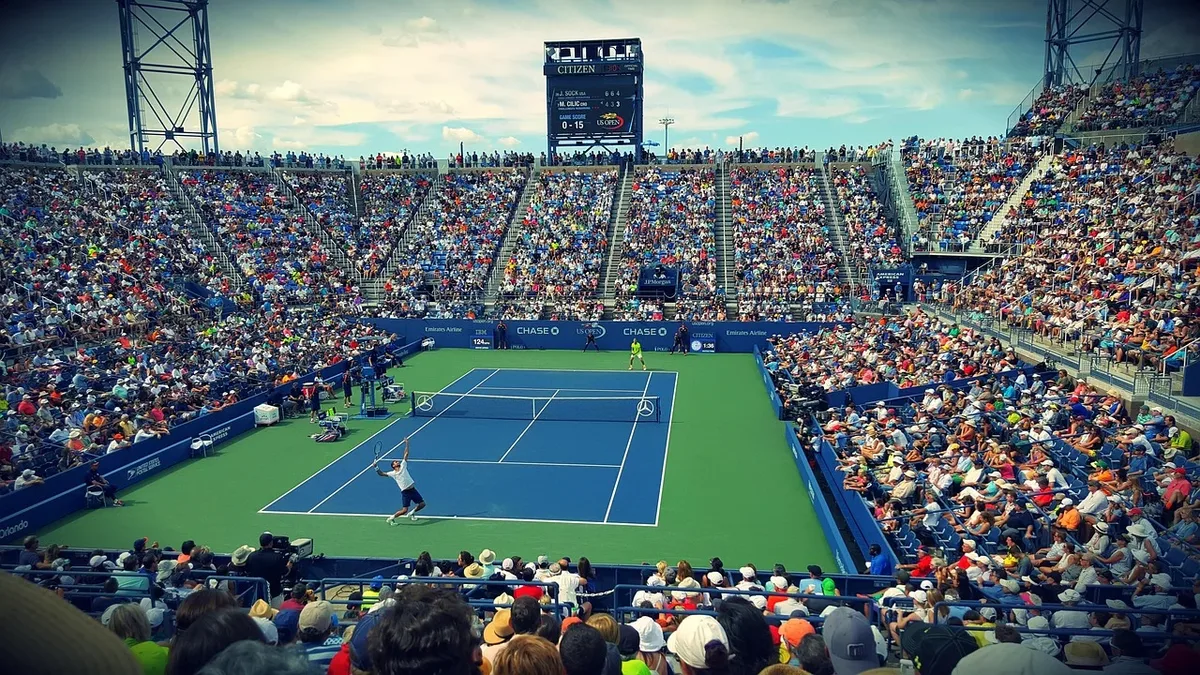
Louis Armstrong Stadium
| Capacity | 14,053 |
|---|---|
| Location | Flushing Meadows–Corona Park, Queens, New York City |
| Surface | DecoTurf hard courts |
| Part of | USTA Billie Jean King National Tennis Center |
| Type | Outdoor stadium with retractable roof |
| Opened | 2018 (new stadium; original 1978 structure demolished) |
Origin and history
Louis Armstrong Stadium is a tennis venue located in Flushing Meadows, Queens, New York City, United States. The original stadium of that name was constructed in the late 1970s as part of the broader National Tennis Center development. It was named in honor of the legendary jazz musician and Queens resident, Louis Armstrong, with the official opening coinciding with the 1978 US Open. That original structure served as the tournament's primary show court until the completion of Arthur Ashe Stadium in 1997, after which it was relegated to a secondary role. The decision was made in the 2010s to completely demolish the old stadium and construct a new facility on the same site. The new Louis Armstrong Stadium, featuring a retractable roof, opened for the 2018 US Open tournament.
What it is for
Louis Armstrong Stadium is a dedicated tennis competition venue used during the annual US Open Grand Slam tournament. Its primary function is to host major matches throughout the tournament draw, typically including quarterfinal, fourth-round, and third-round singles matches for both men and women. The stadium operates as the second-largest court at the USTA Billie Jean King National Tennis Center, with Arthur Ashe Stadium being the largest. It is designed to accommodate high-stakes matches where significant ranking points and prize money are on the line for professional players. The retractable roof ensures match continuity regardless of weather, which is critical for maintaining the strict schedule of a Grand Slam. The venue also hosts doubles and junior matches during the tournament's earlier rounds, serving as a pivotal site for the overall event logistics.
Pros and cons
A significant pro of Louis Armstrong Stadium is its modern retractable roof, which eliminates lengthy rain delays and guarantees match play for the important contests scheduled there. The stadium's design offers more intimate sightlines for spectators compared to the vast Arthur Ashe Stadium, creating a more intense atmosphere. However, a notable con is that its placement and roof can create challenging wind conditions and acoustic noise that some players find disruptive to their concentration. Players who rely on precise ball tosses or subtle auditory cues can regret being scheduled there when the roof is closed and the crowd noise becomes trapped and amplified. The common mistake for tournament schedulers is overestimating the court's speed or bounce consistency compared to other show courts, which can unfairly advantage certain playing styles. Furthermore, while the capacity is substantial, its status as the second court means some highly anticipated matches featuring top-ranked players may be assigned there, which can lead to ticket access issues for fans.
Who it suits
This stadium suits spectators seeking to watch high-level tennis in a venue that feels more connected to the action than the largest arena. It is ideal for fans who prioritize guaranteed play thanks to the roof, ensuring they see a complete match regardless of weather forecasts. The venue suits tournament organizers needing a reliable, large-capacity secondary court to manage a packed match schedule, especially during the middle weekend when the draw is still dense. It is well-suited for players ranked just outside the top seeds who are assigned to it for breakthrough matches, as the energetic atmosphere can provide a notable boost. Conversely, it is less suited for players who are particularly sensitive to variable environmental conditions or enclosed stadium noise. The stadium ultimately serves the broader tournament ecosystem by ensuring critical matches with major ranking implications are played on time and before a significant audience.